
Chicken legs are the core product of broiler slaughter and segmentation, including three sub categories: whole legs, thighs, and calves. The meat is compact and the fat distribution is even, making it the mainstream raw material for fresh food sales and cooked food processing. The slaughtering and processing of fresh chicken legs strictly follows the "Livestock and Poultry Slaughtering Operating Procedures for Chickens" (GB/T 19478-2018) standard, and implements aseptic and standardized operations throughout the process, taking into account product integrity, taste, and food safety. The entire process is divided into five core steps: pre slaughter pretreatment, fine segmentation, finishing and cleaning, pre cooling and preservation, and graded packaging.
Pre slaughter and pre-treatment are the foundation of chicken leg quality, directly affecting the taste and shelf life of the meat. After waiting for slaughter and resting, and passing inspection and quarantine, live chickens enter the assembly line for operation, sequentially completing the processes of hanging chickens, inducing fainting with hemp and electricity, bloodletting by assassination, hair removal by soaking and scalding, and clean chamber quarantine. Madness induced fainting can prevent stress induced bruising in chickens and ensure that the chicken leg meat is transparent and free of blood spots; Assassination requires precise cutting of the carotid artery and jugular vein, with strict control of the bleeding time within 3-5 minutes to ensure thorough bloodletting and prevent problems such as redness and accelerated deterioration of the meat. The soaking water temperature is stable at around 60 ℃, and flowing warm water is used for soaking, which can completely remove feathers without burning the chicken skin or damaging the surface meat of the chicken leg. After hair removal, manual and equipment joint cleaning of residual hair, yellow skin, and foot skin is carried out to ensure the cleanliness of the body. The cleaning process requires the complete removal of internal organs, crop, and residual trachea, strictly avoiding bile and fecal contamination of the body. Contaminated bodies need to be separately cleaned and retested to prevent them from flowing into the next process.
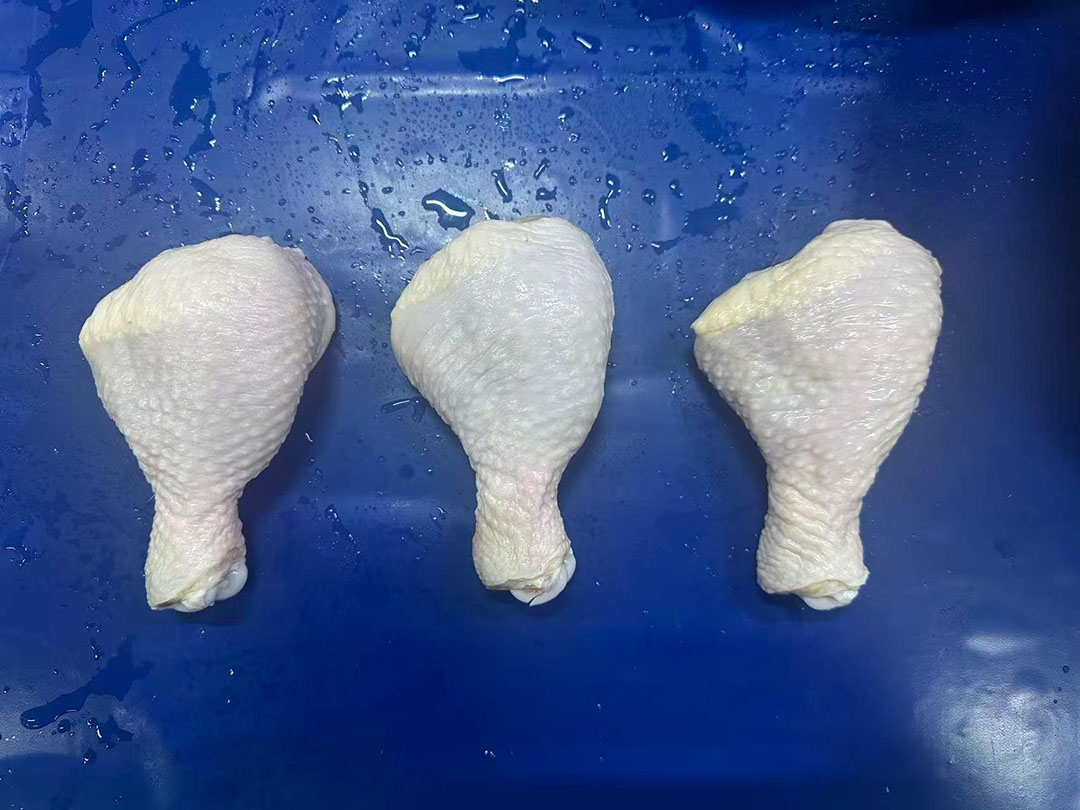
Fine segmentation is the core process of chicken leg processing, which requires ensuring regular shape and complete bone and meat. After cooling, the body temperature of the chicken carcass drops to 0-4 ℃ and enters the segmentation assembly line. The operator uses a sterilization special tool to accurately cut the skin along the groin position of the chicken body, gently pry the thigh towards the back, accurately cut off the hip joint connecting tendon, and completely remove the chicken leg, ensuring that the leg skin surface is fully covered, the edges are neat, and there is no damage. Subsequently, according to product requirements, the whole leg product retains the complete structure of the thigh and calf; The thigh product is precisely cut along the knee joint, preserving the fleshy part from the hip joint to the knee joint; Cut the calf product from the knee joint to the tarsal joint, and remove the excess part of the chicken feet. The incision should be smooth without broken bones or meat. The cutting tools and cutting boards are disinfected one by one throughout the entire process, and operators wear sterile protective equipment to prevent cross contamination.
The quality of fresh chicken legs is determined by the maintenance, cleaning, and pre cooling preservation. The segmented chicken legs need to be finely trimmed manually, removing residual lymph, blood clots, fascia, and broken bones, trimming irregular edges and corners, removing excess oil, and ensuring a uniform and neat appearance of the product. After the trimming is completed, low-temperature flowing water is sprayed and cleaned thoroughly to wash away surface impurities and fine blood. After cleaning, it immediately enters the pre cooling workshop and uses ice water pre cooling to quickly reduce the center temperature of the chicken leg to 0-4 ℃, inhibit bacterial growth, lock in meat moisture, and avoid meat drying and wood burning. The pre cooling duration is strictly controlled to ensure sufficient cooling and prevent the meat from absorbing water and becoming loose due to prolonged soaking.
Finally, the chicken legs are classified into three levels: special grade, first grade, and second grade, based on weight, appearance, and integrity. Any broken skin, bruises, bones, or contaminated defective products are removed. Qualified products are packaged in food grade vacuum packaging, which isolates air and prevents oxidation and deterioration. The packaging is labeled with production date, grade, shelf life, and other information. The entire process is stored and transported in a low-temperature cold chain, with a stable storage temperature below -18 ℃, and can be stored for a long time. The fresh cold chain circulation can guarantee 72 hours of fresh quality. Strictly implement microbiological control throughout the process, regularly test the total number of bacterial colonies, and ensure compliance with fresh poultry food safety standards.