
Chicken wings are divided into three independent categories: wing root, wing center, and wing tip. They have tender meat, low fat content, and rich gelatinous content, making them highly valuable products in poultry processing. Chicken wings are small in size and have tender meat. Compared to chicken legs, slaughter and processing require higher precision, with a focus on avoiding problems such as skin breakage, bone breakage, meat damage, and blood contamination. The entire process follows the standards of refinement, light operation, and aseptic processing, and is suitable for various application scenarios such as fresh food sales, frozen storage, and cooked food pickling.
The pre-treatment of chicken wings before slaughter focuses on gentle operation to protect the delicate meat quality. After completing quarantine, rest, and electrocution of live chickens, they should be euthanized and bled in a standardized manner for 3-5 minutes to ensure that the carcass is free of bruising. The soaking and scalding process strictly controls the water temperature and time. Compared to chicken leg processing, the soaking and scalding temperature of chicken wings is slightly lower and the duration is slightly shorter to avoid high temperature burns to the wing skin, causing skin damage and whitening of the meat. Hair removal adopts a mechanical hair removal+manual refinement mode, gently removing feathers and fine hairs on the surface of chicken wings, cleaning up yellow skin and impurities, and preventing violent pulling from causing wing deformation and skin breakage. In the process of cleaning the chamber and body, special attention should be paid to protecting the wings to avoid collision and compression, prevent wing bone breakage and meat damage. Chicken wings contaminated with pollutants should be treated separately, and it is strictly prohibited to mix them with qualified products.
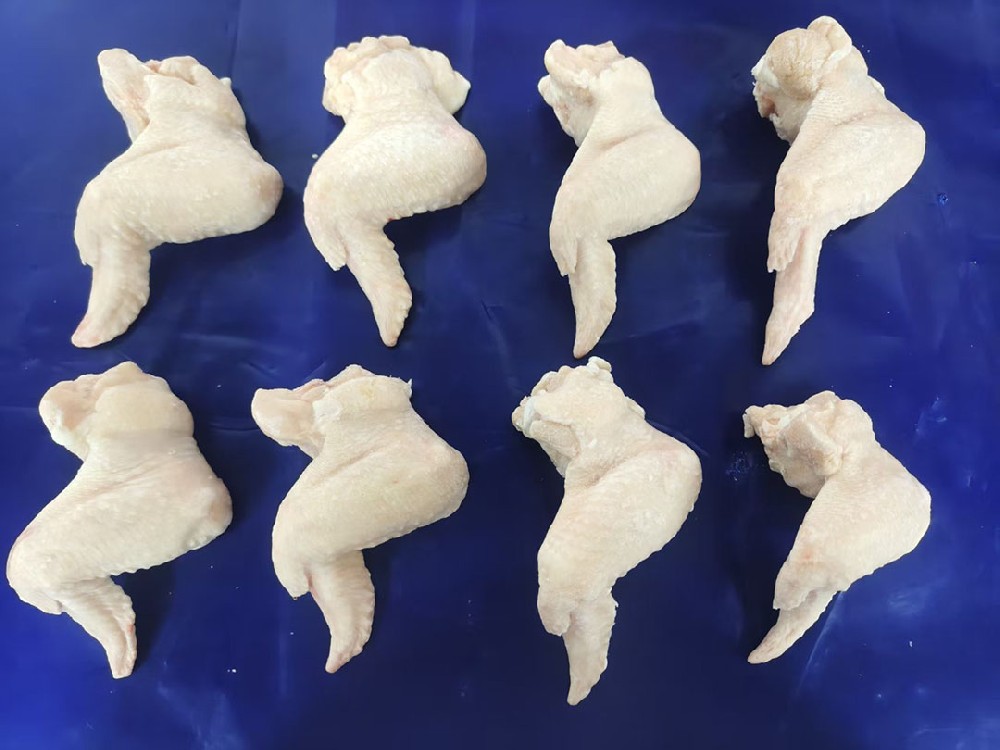
Accurate segmentation is the core process of chicken wing processing, which determines the product phase and grading. The chicken carcass cooled to 0-4 ℃ enters the segmentation assembly line. The operator uses ultra-thin sterilization tools to accurately locate the connection joints between the chicken wings and the chicken body, quickly and cleanly cut off the connecting tendons and bones, and completely remove the entire wing to ensure the integrity of the wing body, no tearing of the skin, and no loss of meat. Subsequently, segmentation was carried out according to product requirements: cutting off from the connection between the wing root and the wing center, separating the wing root and the wing center, and then dividing the wing tip from the end of the wing center. The incisions for all three categories were smooth, without broken bones or residual meat adhesion. Handle the entire process with care to avoid squeezing or bending the wings, and prevent problems such as broken wing bones, wrinkled skin, and bloody flesh.
Repair, cleaning, pre cooling, and quick freezing to ensure the freshness and quality of chicken wings. After segmentation, various types of chicken wings are manually trimmed one by one, removing residual fine hairs, blood clots, fascia, trimming irregular edges and corners, and cleaning up bone debris and impurities at joints. After finishing, gently spray and clean with low-temperature flowing water to thoroughly remove surface blood and impurities, and drain the water. Fresh chicken wings are immediately pre cooled at 0-4 ℃ for preservation, rapidly reducing temperature and inhibiting bacteria to maintain the freshness and tenderness of the meat; Frozen chicken wings are sent to ultra-low temperature freezing equipment, which locks in freshness at -35 ℃ to retain moisture and gum in the meat, preventing it from drying out and aging. Strictly follow hygiene standards throughout the entire processing process, disinfect cutting tools, equipment, and workstations regularly, and ensure that operators perform sterile operations to prevent microbial cross contamination.
Graded packaging and quality identification are the key finishing steps in chicken wing processing. According to the appearance integrity, weight, skin condition, and presence of bruises and defects, chicken wings are classified into three levels: high-quality, qualified, and defective. High quality chicken wings have a complete shape, smooth and undamaged skin, no bruising, no broken bones, and a natural pink and tender color; Qualified chicken wings with slight edge defects and no quality or safety issues; Chicken wings with broken skin, bones, large areas of blood stasis, and odor pollution shall be uniformly removed and treated. After grading, fresh chicken wings are packaged for preservation and sold in low-temperature cold chain. Frozen chicken wings are vacuum sealed and stored at a constant temperature.